
Dangote Says Nigeria’s Petrol Is Cheaper—What 8 Months of Fuel Price Data Across West Africa Shows | January–August 2026
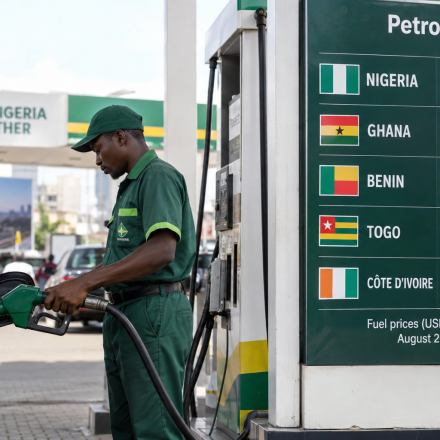
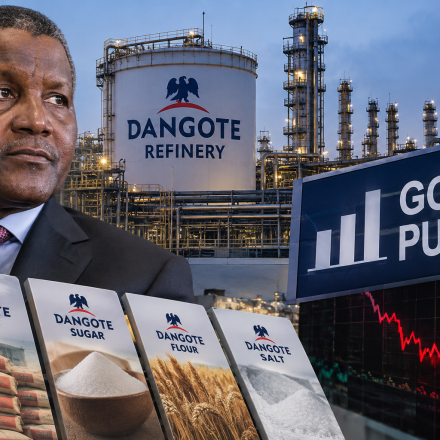
On AriseTV, Tuesday, 15 September 2026, during an interview, Aliko Dangote was heard saying that petrol prices in neighbouring countries were 30–50 per cent higher than in Nigeria which create an arbitrage incentive for fuel to move across Nigeria’s borders to those countries.
The simple question here is: is petrol actually cheaper in Nigeria than in Ghana, Benin, Togo and Côte d’Ivoire?
What does the data for January to August 2026 say?
To answer this questions, data on petrol prices across the five countries were collected and analyzed. The data collected and compiled says that, on a dollar-equivalent basis, Nigeria was the cheapest of the five markets for petrol in every month from January to August 2026. But how cheap Nigerian petrol is relative to her neighbours for the period under consideration was not constant.
At Nigeria’s May peak, Ghana briefly became almost identical in dollar terms, while Benin, Togo and Côte d’Ivoire remained materially higher in petrol prices.
Our investigation therefore finds support for the broad direction of the claim by the business mogul that petrol prices were higher in the neighbouring countries than in Nigeria, but not exactly in the magnitude of 30–50 per cent premium insinuated by him.
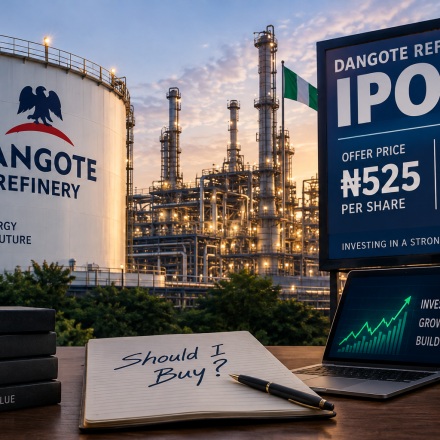
READ also: Dangote Refinery IPO at ₦525: Should You Buy? The ₦65 Trillion Valuation Explained
What the Data Reveals
• Pump price for petrol in Nigeria moved from $0.731 per litre in January 2026 to a peak of $1.165 per litre in May, then fell to $0.899 per litre in August 2026. That is a 59.4% rise from January to May, followed by a 22.8% decline from May to August.
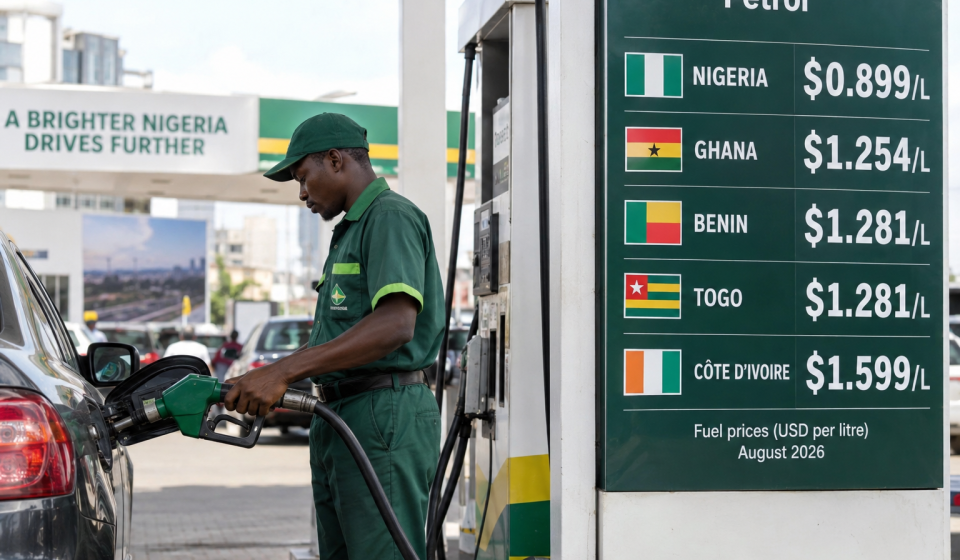
• In August, petrol cost about $0.899 per litre in Nigeria, $1.254 in Ghana, $1.281 in Benin, $1.281 in Togo and $1.599 in Côte d’Ivoire. Relative to Nigeria, the August premiums were about 39.4%, 42.5%, 42.5% and 77.9% respectively which was to a certain extent outside the range mentioned by Dangote.
• In May, petrol in Ghana was minutely cheaper by about half a cent per litre than petrol in Nigeria at $1.160 per litre to Nigeria $1.165 per litre.
• Petrol prices in Nigeria during the period under consideration is highly volatile. Its H1 petrol average rose from ₦1,035 per litre in January to ₦1,596 per litre in May before dropping to ₦1,300 per litre in June. That’s understandable; the market for petroleum products is deregulated in Nigeria unlike her neighbours.
• Petrol prices in Benin and Togo were comparatively stable until May. Côte d’Ivoire followed a stepwise administered-price pattern. It was constant at $1.47 (i.e., 820 CFA) per litre from January to April and at roughly $1.56 (i.e., 875 CFA) May to June before shooting up to approximately $1.60 (i.e., 905 CFA) in August.
The Five-Country Fuel Price per Litre Scorecard in USD
| Month | 🇳🇬 Nigeria | 🇬🇭 Ghana | 🇧🇯 Benin | 🇹🇬 Togo | 🇨🇮 Côte d’Ivoire |
| Jan 2026 | $0.731 | $0.971 | $1.243 | $1.216 | $1.467 |
| Feb 2026 | $0.775 | $0.937 | $1.253 | $1.226 | $1.478 |
| Mar 2026 | $0.934 | $1.015 | $1.226 | $1.199 | $1.446 |
| Apr 2026 | $1.126 | $1.202 | $1.239 | $1.212 | $1.461 |
| May 2026 | $1.165 | $1.160 | $1.290 | $1.250 | $1.557 |
| Jun 2026 | $0.950 | $1.174 | $1.273 | $1.273 | $1.537 |
| Jul 2026 | $0.885 | $1.133 | $1.262 | $1.262 | $1.523 |
| Aug 2026 | $0.899 | $1.254 | $1.281 | $1.281 | $1.599 |
| 8-month average | $0.933 | $1.105 | $1.258 | $1.240 | $1.509 |
Note: Bold monthly figures indicate the lowest US-dollar petrol price among the five countries in that month. Ghana values reflect the stated retail/floor basis in the underlying dataset. Nigeria’s July–August figures are reference/market observations rather than national monthly averages. Figures are rounded to three decimal places; averages are calculated from the unrounded monthly values.
Need a reliable & affordable domain name and web hosing: Click Here
What Did Fuel Cost When 2026 Began?
In January, petrol pump price was ₦1,035 ($0.731) per litre in Nigeria. It was GH¢10.44 (i.e., $0.971) per litre Ghana $0.971/L, 680 CFA ($1.216) in Togo, 695 ($1.243) in Benin and 820 ($1.467) in Côte d’Ivoire.
Petrol price in Nigeria for January 2026 was therefore roughly 24.7% below Ghana, 39.9% below Togo, 41.2% below Benin and 50.2% below Côte d’Ivoire. Notably, exchange rates in the triumvirate countries (Togo, Benin and Côte d’Ivoire) are similar, and more importantly these former French colonies use similar currency i.e., CFA.
The opening-month data already shows why local-currency comparisons are misleading: ₦1,035, GH¢10.44 and 695–820 FCFA cannot be compared until each is translated into a common unit.
Eight Months of Price Changes: Which Country Increased Prices Most?
Using the US dollar as a common currency for the five nations, Nigeria’s petrol price rose by 23.1% between January and August; Ghana rose 29.2%; Benin 3.1%; Togo 5.3%; and Côte d’Ivoire 9.1% for the same period.
These endpoint changes conceal the path. Nigeria’s May peak was far more dramatic than its August endpoint suggests. Ghana also moved sharply, especially into April and August. The three CFA-franc markets changed in discrete steps rather than the rapid month-to-month movement visible in Nigeria and Ghana. This confirms that these changes in the three franco-phone countries are centrally-engineered.
READ also: Dangote Refinery IPO: Did Investors Make Money From Other Dangote Stocks?
How Nigeria, Ghana, Benin, Togo and Côte d’Ivoire Set Prices
In the first half of the year, Nigeria’s petrol price series was ₦1,035, ₦1,051, ₦1,289, ₦1,533, ₦1,596 and ₦1,300 per litre. In dollar terms, the rise was equally visible: $0.731 in January, $0.775 in February, $0.934 in March, $1.126 in April and $1.165 in May, before dropping to $0.950 in June.
July’s Dangote gantry reference of ₦1,215 translated to $0.885, while August market observations around ₦1,217 translated to $0.899.
The data shows a mixed result for Ghana and the three francophone countries.
Ghana, like Nigeria, does not have one single pump price for petrol. The figures for petrol prices for the country are minimum ex-pump floors, not necessarily the final price at every station. And massive variations in Ghana’s pump price over the eight-month period gives an indication of a deregulated petrol market.
Benin, Togo and Côte d’Ivoire largely use administered national pump prices that remain in force until formally changed. A stable number in Cotonou, Lomé or Abidjan does not mean the underlying market cost is stable; it means the market for petrol in the countries is regulated centrally by the government.
Petrol Price Comparison — January to August 2026
| Country | 8-Month Average Price (US$/Litre) | Nigeria = 100% | Premium vs Nigeria |
| 🇳🇬 Nigeria | $0.933 | 100.00% | Base |
| 🇬🇭 Ghana | $1.105 | 118.40% | 18.40% |
| 🇧🇯 Benin | $1.258 | 134.80% | 34.80% |
| 🇹🇬 Togo | $1.240 | 132.90% | 32.90% |
| 🇨🇮 Côte d’Ivoire | $1.509 | 161.70% | 61.70% |
How Petrol Prices Compare Across West Africa: Nigeria as the Benchmark
The CFA Franc and the Border Economics: The Smuggling and Arbitrage Question
Currency conversion is the backbone of this comparison. In January, Nigeria’s ₦1,035 per litre becomes $0.731 at ₦1,417/US$; Benin’s 695 FCFA becomes $1.243 at 559.1 FCFA/US$; and Ghana’s GH¢10.44 becomes $0.971 at GH¢10.757/US$. Without this conversion, the regional ranking is meaningless.
Benin, Togo and Côte d’Ivoire share the same CFA currency and almost similar exchange-rates. Their dollar-equivalent petrol prices were much less volatile than Nigeria’s. That is an observable result.
In January, Benin petrol was about 70.1% more expensive than Nigeria’s in dollar terms; Togo 66.5% higher; Ghana 32.8% higher; and Côte d’Ivoire 100.7% higher.
By August, the gaps versus Nigeria were about 42.5% for Benin and Togo, 39.4% for Ghana and 77.9% for Côte d’Ivoire. Those are gross pump-price differentials, not smuggling profits.
Transport, handling, border risk, losses and enforcement costs are unknown. The evidence therefore supports the existence of potential arbitrage incentives, but not a claim that a particular cross-border trade would yield a stated net return.
The Affordability Test: Price Is Not the Same as Burden
This is a critical distinction that the present dataset on petrol prices does not resolve.
Nigeria can have the lowest dollar-equivalent petrol price and still impose a heavier burden on households if incomes are lower. Minimum wages, average earnings and GDP-per-capita data were not considered in this analysis.
This report therefore separates ‘cheapest price’ from ‘most affordable fuel’ and makes no affordability ranking in this regard.
The affordability of petrol cannot be determined solely on the lower price of the product in Nigeria. The question is: what is the minimum wage in those neighbouring countries?
If their minimum wage is higher, the idea of cheap petrol no longer really counts because affordability is more than just the price of the product but also a function of the level of income.
The Regional Ranking: Cheapest and Most Expensive Fuel
Across the January–August common-currency petrol series, Nigeria occupied the lowest position in seven of eight months and was effectively tied with Ghana in May, when Ghana was fractionally lower in term of fuel price. Côte d’Ivoire was the highest-priced market in every month. Benin and Togo clustered closely in the middle, with Ghana generally below them.
The largest January-to-August petrol increase in dollar terms occurred in Ghana at about 29.2%, followed by Nigeria at 23.1%, Côte d’Ivoire at 9.1%, Togo at 5.3% and Benin at 3.1%. But endpoint change is not the same as volatility: Nigeria’s intra-period swing was much larger, with a $0.434 per litre range between its January low and May high.
What the Numbers Do Not Tell Us
There are important limitations. Nigeria’s Jan–Jun figures are monthly averages, while July–September rely on gantry, depot or market observations. Ghana mixes actual Oil Marketing Companies (OMC) observations and National Petroleum Authority (NPA) regulatory floors. Benin, Togo and Côte d’Ivoire largely use administered prices. Station-level price coverage is incomplete, and the data does not include taxes, crude prices, incomes, inflation or border transaction costs.
Conclusion: Is Nigeria Really Paying More?
On the narrow question of nominal petrol price converted into US dollars, the answer from the supplied January–August data is largely no: Nigeria was generally cheaper than the four comparison markets.
And the statement of the Dangote is correct and true. The more precise finding is that the gap changed sharply over time. In August, Ghana, Benin and Togo were roughly 39–43% above Nigeria, while Côte d’Ivoire was about 78% above.
In May, however, Nigeria and Ghana were essentially at parity. The evidence therefore supports a substantial regional price-arbitrage story, but it does not support treating ‘30–50% higher’ as a universal description of every neighbour in every month.
The impact of the exchange rate was also noticeable in the wide gaps in the gasoline prices between Nigeria and her neighbours.
Methodology and Source Notes
The investigation covers 1 January to 31 August 2026 and uses only price figures and exchange rates.
For January–August cross-country petrol comparisons, local prices were converted to US dollars using the contemporaneous monthly NGN/USD, GHS/USD and CFA/USD rates. Where a month contains two pricing windows, the supplied monthly figure or stated midpoint/reference was retained.
Nigeria’s Jan–Jun values are monthly averages; later Nigeria observations are explicitly treated as market/gantry/depot references. Ghana’s regulatory floors are not represented as universal retail prices. No other external data was used.