


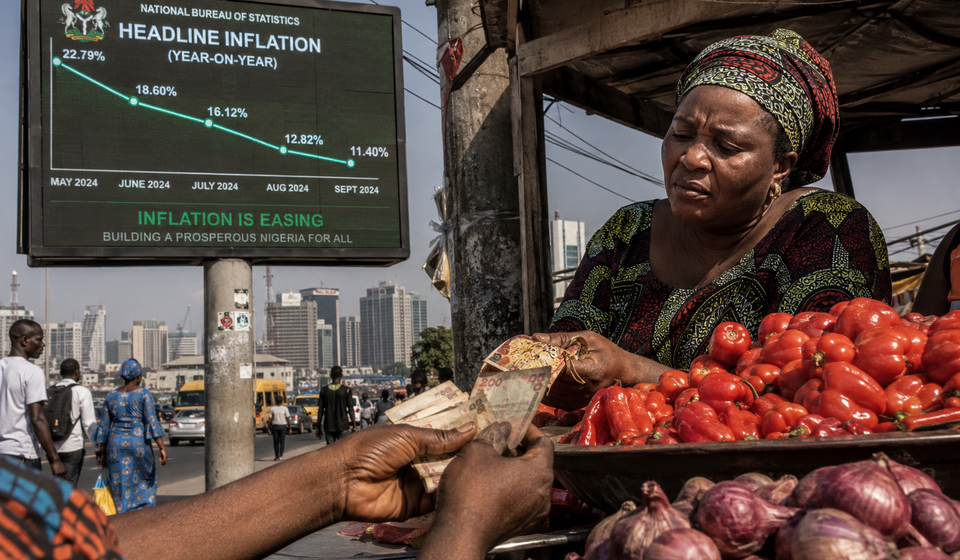
Inflation Is Slowing in Nigeria—but Food Prices Are Rising. How Can Both Be True?
“Rising food prices weaken Nigeria’s disinflation gains.”
That was the headline on August 18, 2026 in the BusinessDay. The gist of the story: Nigeria’s headline inflation dropped in July 2026. Good news, right? Except that food prices kept climbing. Unabated, as they say.
What does disinflation actually mean?
First, the important distinction: A fall in the inflation rate does not necessarily mean that prices have fallen. Inflation measures how quickly the general price level is increasing. When the rate declines, prices may still be rising—just more slowly than before. Economists call that disinflation. An actual fall in the general price level is called deflation. That is a different event entirely.
Suppose inflation drops from 20% to 15%. Prices have not gone back to where they were. They are still increasing, only at a slower annual rate. For someone whose income hasn’t changed, purchasing power may therefore continue to weaken.
Click here for a reliable & affordable domain name and web hosting.
So no, a lower inflation rate does not automatically mean you are better off than you were last year.
Inflation Is Slowing in Nigeria—but Food Prices Are Rising. How Can Both Be True?
So let me get this straight. Your purchasing power—generally speaking—based on this report improves. But at the same time, what you can buy at the market in term of food items shrinks? The same income, fewer bags of rice. How does that work? Is this some contradictions peculiar to Nigeria, or is there an actual logic beneath the numbers?
Here’s what I know: we all want inflation—that general rise in prices of goods and services across the board—to ease. This makes sense. Lower inflation should mean your naira or unit of currency stretches further in terms of what it can purchase for you. But a drop in headline inflation while food prices keep skyrocketing? To the average Lagosian, that sounds like a misnomer. An oxymoron, even. How can the general price level be cooling when the one thing you buy every single day is getting more expensive? How can the general rate of inflation fall while the prices of rice, beans, garri and other food items continue to rise? And if inflation is easing, shouldn’t ₦50,000 buy more food—not less as insinuated by the recent report?
The short answer is: it’s not a contradiction. It’s just that we’re looking at two different things.
Does headline inflation exclude food and energy?
No. Headline inflation includes the complete consumer basket, including food and energy.
It is core inflation that commonly excludes volatile items such as farm produce and energy. Nigeria’s core inflation measure is often described as “all items less farm produce and energy.”
Why remove them?
Most countries measure something called “core inflation.” And core inflation? It excludes food and energy prices. But why? Because those prices are notoriously jumpy. They can be erratic. One bad harvest, one geopolitical dustup like the US-Iran conflict, and suddenly tomatoes cost twice what they did last week. Including those spikes in your main inflation metric would make the whole thing look like a roller coaster—not exactly useful for long-term policy decisions.
Take Nigeria specifically. Food prices spiking? That’s not random. Low harvest yields. Crop destruction from flooding and low rainfall. And let’s not dance around it: the insecurity. Boko Haram, banditry, kidnapping—these aren’t just security problems; they’re economic ones too. Farmers get driven off their land, production plummets, and demand for foods? That doesn’t budge. So the prices of food items go up. It’s as simple as that.
In the same vein. energy also tells a similar story. The US-Iran conflict that’s been simmering since February 2026? That’s pushed petrol from roughly ₦850 to ₦1,250 per litre in Nigeria. And that ripple effect touches everything—including the cost of getting food from farm to market.
What did the research discover?
Emmanuel Kohlscheen’s 2022 paper for the BIS, “Understanding the Food Component of Inflation”—looked at 35 countries over 30 years. Mostly OECD nations. And here’s what it found: food CPI inflation isn’t some exogenous shock you just have to accept. It’s tied to broader macroeconomic conditions. Among other things, consumer expectations matter.
The research actually shows, which is where it gets interesting, that food prices respond to expectations. Professional forecasters get on TV, predict inflation will keep rising, and lo and behold, retailers adjust their prices in anticipation of price increase. It becomes a self-fulfilling prophecy. Add in the fuel subsidy removal and the naira floatation, and you had months of exactly this dynamic playing out. Experts kept predicting higher inflation, traders kept hiking the prices of food items, and the whole thing became a feedback loop.
Here’s something counterintuitive though: importing more food? Food importation doesn’t help as much as you’d think. A 10% increase in food imports only reduces inflation by about 0.3%. What about Domestic crop growth? Does it impact significantly on inflation? Research tells a different story from that of food importation. A 10% bump or increase in local harvest knocks 47 basis points off food inflation. This means local food production matters a lot. It matters a lot more than importing food as far as lowering food inflation is concerned.
And what about global food prices? That’s the international prices of food items? Surprisingly there is a weak link between the prices of food at the global level and what happens in Nigerian markets. The connection just isn’t that strong at all.
The major conclusion drawn from the research is that domestic crop yields are the real lever. Ceteris paribus, better harvests mean cheaper food. International trade provides some buffer—especially when weather shocks hit different regions at different times—but it’s imperfect. The substitutability between local and imported food just isn’t complete.
Now let’s talk numbers—because the data tells a stark story. Headline inflation dropped to 15.43% year-on-year. But food inflation? That stood at 26.20% in July 2026. Compare that to 20.31% in July 2025. Same twelve-month window, completely different trajectories.
What this means for you?
Imagine you earned ₦100,000 in July 2025. You split it: ₦50,000 for food, ₦50,000 for everything else. Last year, that ₦50,000 bought you five units of food and five units of other goods.
Now it’s July 2026. Same income. That ₦50,000 for other goods? It stretches further—maybe it can buy you six units instead of five. Good news. But that same ₦50,000 for food? It buys you four units now. Maybe less.
So yes, headline inflation says you’re better off. But your dinner table tells a different story.
The big takeaway? Lower headline inflation and rising food prices can coexist. They’re not contradictions; they’re just different measures telling different parts of the story. For the man on the street in Lagos, that distinction probably feels academic. When you’re standing in the market and the price of garri has doubled, the statisticians can explain all they want. Your wallet doesn’t care about the methodology.
One more thing: the energy-food connection wasn’t as strong as expected. Oil price changes don’t seem to drive food inflation as directly as you’d think. It’s the domestic stuff—harvests, security, expectations—that really moves the needle.
So next time you see that headline—”inflation drops, food prices rise”—you’ll know it’s not nonsense. It’s just Nigeria’s economic reality wearing two different faces at the same time.