

Dangote Refinery IPO: Did Investors Make Money From Other Dangote Stocks?
If you buy this Dangote Refinery IPO, what will happen to your money?
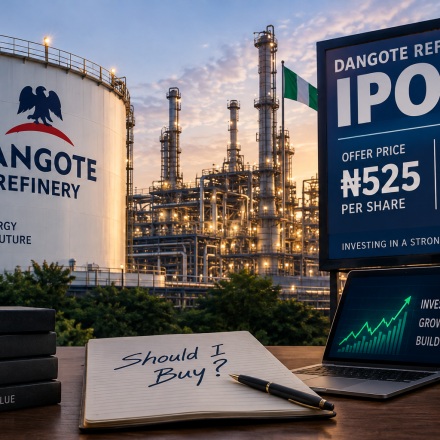
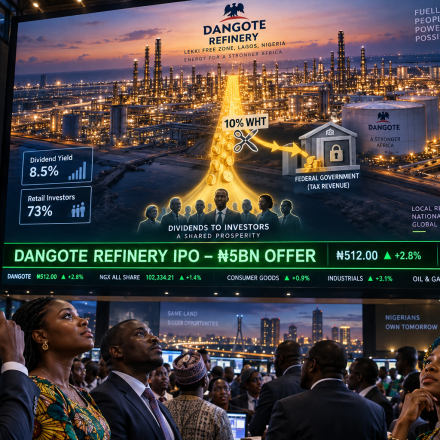
The news of Dangote Refinery’s Initial Public Offer (IPO) has been difficult to miss. The refinery is going public at ₦525 per share, the offer opens on Sept. 14, 2026, and investors can get in with as little as ₦5,250 (10 units of share).
For many Nigerians, that may sound like an opportunity to own a small piece of one of Africa’s biggest industrial projects. But choosing whether to buy a stock poses a different problem.
A famous business founder’s name (like Dangote) does not tell you whether a share is cheap. Neither does the size of the refinery. And an impressive company does not automatically make an impressive investment at whatever price investors are asked to pay.
So before putting money into Dangote Refinery, there is a useful question to ask: What happened to people who bought shares in Dangote’s other publicly traded companies?
The answer is more complicated than you might expect.
One thing you should know: Dangote has been here before.
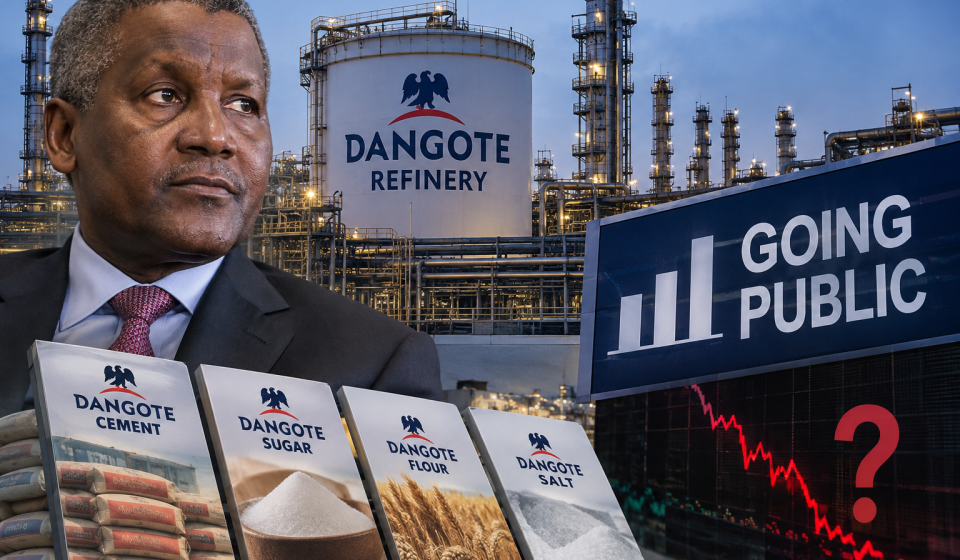
Dangote Group currently has three publicly listed companies: Dangote Cement Plc, Dangote Sugar Refinery Plc and NASCON Allied Industries Plc. There is also a fourth historical case worth remembering: Dangote Flour Mills Plc, which was once publicly traded but was eventually acquired and delisted. These four companies have stories to tell.
But those four stories did not end the same way.
Dangote Sugar Refinery offers perhaps the simplest place to begin
Dangote Refinery offered 3 billion ordinary shares at ₦18 each at its IPO. The company which commenced business in March 2000 as a refiner of sugar opened applications in November, 2007, and closed in December of that year.
They did not remain at ₦18 per share for long.
On the first day of trading after IPO, the shares appreciated by the maximum 5% then permitted. By Sept. 11, 2026, Dangote Sugar was trading at around ₦69.
This is a seemingly impressive journey: ₦18 to about ₦69 which is a nominal increase of roughly 283% in value over the course of 19 years since its first appearance as a publicly quoted company.
But before you celebrate, there is a catch.
The journey took almost 20 years. The comparison also ignores dividends, rights issues, inflation and the time value of money. An investor whose ₦18 share becomes ₦69 nearly two decades later has made a nominal gain, but that does not necessarily mean his purchasing power has increased by 283%.
If for instance you purchased 1000 units of Dangote shares in 2007 at ₦18 per unit (i.e. ₦18000), that means if you’re to sell them now, you will receive ₦69,000. The question is: can your ₦69,000 now purchase what your ₦18,000 then in 2007 could buy? If not, the meaning is that the purchasing power of your investment has not really kept pace with the value of your investment. And that’s to me and every astute investor is a very big deal! In doing this analysis, and to really determine the true return on shareholder’s investment, the dividends received from inception to date must also be factored in.
READ also: Nigeria’s Dividend Tax Rules—Here’s What Investors Need to Know in 2026
And Dangote Sugar has another complication.
In 2026, the company completed a large rights issue involving about 8.10 billion new shares at ₦60 each, targeting approximately ₦485.9 billion.
That means anyone trying to compare the company’s share price in 2007 with its share price today needs to account for what happened to the company’s capital structure along the way. Otherwise, a simple line chart can tell a deceptively simple story about a complicated investment.
Then there is Dangote Cement
If Dangote Sugar provides the cleanest IPO comparison, Dangote Cement provides the most spectacular long-term share-price story as it relates to the Dangote conglomerate.
But here is something investors should know: Dangote Cement did not enter the market through a conventional retail IPO.
The company emerged following the merger of Dangote Cement Plc (formerly known as Obajana Cement Plc) and Benue Cement Company Plc. The enlarged company was then listed on Oct. 26, 2010, at ₦135 per share with an IPO of ₦15.5 billion shares.
What happened immediately afterward? Almost nothing.
Need a reliable & affordable domain name and web hosing: Click Here
The stock remained at ₦135 on Oct. 26. It remained at ₦135 on Oct. 27. Again, ₦135 on Oct. 28. And ₦135 on Oct. 29. By Nov. 2, it had fallen to ₦128.25.
Anyone expecting the Dangote name to produce an automatic first-day jackpot would have been disappointed.
But look farther out and the picture changes dramatically.
By September 2026, Dangote Cement was trading at around ₦1,034 per share. ₦135 had become approximately ₦1,034.
That represents a price increase of about 666%, before dividends. And because Dangote Cement has repeatedly paid cash dividends, its total shareholder return would be higher than the share-price increase alone.
That distinction matters.
An investor looking at Dangote Refinery should not ask only what might happen during its first trading session. The history of Dangote Cement shows just how different a first week and a 16-year investment can look.
What about NASCON?
NASCON Allied Industries presents a different problem.
The company traces its history to the National Salt Company of Nigeria, which was incorporated in 1973, privatised and listed on Oct. 20, 1992. Dangote Industries acquired majority shares through that process.
READ also: Inflation Is Slowing in Nigeria—but Food Prices Are Rising. How Can Both Be True?
Years later, NASCON acquired the assets and operations of Dangote Salt Limited, effectively bringing the Dangote salt business into the quoted company.
So calling NASCON simply another “Dangote IPO” would be misleading.
It wasn’t.
By September 2026, NASCON was trading at around ₦160 to ₦163, after reaching a 52-week high of approximately ₦222. But without the original privatisation prospectus, using an unsupported “IPO price” to calculate what early investors supposedly made would create more certainty than the available evidence allows.
And then there was Dangote Flour Mills
This is the Dangote stock-market story investors may be tempted to forget.
They shouldn’t.
Dangote Flour Mills listed on Feb. 4, 2008. Five billion shares were admitted at ₦15 each, and the share rose to ₦15.75 on its first trading day.
Then the story became much less straightforward.
Dangote sold control of the company to South Africa’s Tiger Brands in 2012. He later reacquired the troubled business. Eventually, Olam acquired the company, paying ₦24 per share under the final 2019 arrangement.
Dangote Flour Mills disappeared from the stock exchange.
The simple endpoint comparison was therefore roughly:
₦15 at listing to ₦24 at exit.
About 60% over approximately 11 years, before dividends.
That is not the same story as Dangote Cement.
And that may be the first useful lesson for anyone preparing to buy Dangote Refinery.
There is no single “Dangote effect”
Look at the four histories together and something becomes clear.
Dangote Cement became an extraordinary long-term stock-market success.
Dangote Sugar produced a substantial nominal increase, although over a very long period and through a history complicated by corporate actions.
NASCON remains a long-running listed consumer company, but its privatisation history makes it an imperfect comparison with a modern IPO.
Dangote Flour Mills changed hands repeatedly and eventually disappeared from the exchange.
The Dangote name did not produce one uniform investment outcome.
That is why the coming refinery IPO deserves to be examined as a business investment rather than a referendum on Aliko Dangote.
And there is another reason.
At ₦525, Dangote Refinery is entering the stock market at a considerably higher nominal share price than Dangote Sugar’s ₦18 public offer, Dangote Flour Mills’ ₦15 listing price or Dangote Cement’s ₦135 listing price.
Does that make Dangote Refinery expensive?
Not necessarily.
In fact, ₦525 by itself tells us remarkably little. And Its approximately ₦65 trillion in value.
To understand why, we need to look at the number hiding behind that share price. What were the purchasing powers during the IPO of Dangote Sugar Refinery, Dangote Cement Plc, NASCON and Dangote Flour Mills? Can ₦525 buy what ₦18 could buy in 2006, ₦15 in 2008 and ₦135 in 2010?
Will climate change revolution, worldwide adoption of electric vehicles and strong advocacy against dependence on fossil fuel impact negatively and significantly on the value of your investment in Dangote Refinery in the future?
Answers to these questions and more could change how you allocate your scarce resources to different investment vehicles especially to Dangote Refinery.
Profitable investment decisions are not emotional hypes but data-driven choices!
Over to you. Drop your thoughts in the comments section below!
- Are you applying for Dangote Refinery’s share or not?
- How do you expect the IPO of Dangote Refinery to perform given the historical listings of other Dangote’s company stocks?
- Will the adoption of electric vehicles and climate change advocacy affect the fortune of Dangote Refinery going into the future?