
Dangote Refinery IPO at ₦525: Should You Buy? The ₦65 Trillion Valuation Explained
A share price can look cheap while the company behind it is expensive
Dangote refinery is very big no doubt. It’s massive and currently the biggest in Africa. But is the offer price of ₦525 cheap or expensive?
Suppose someone offers you a share for ₦525 and another for ₦1,034. Which company is cheaper?
It sounds obvious. But if you considered it thoughtfully, it isn’t.
Dangote Refinery’s ₦525 offer price is lower than the roughly ₦1,034 at which Dangote Cement was trading in September 2026. But that does not make the refinery cheaper than the cement company.
Why? Because a share is only one tiny piece of a company.
READ also: Dangote Refinery IPO: Did Investors Make Money From Other Dangote Stocks?
To understand what investors are actually being asked to pay, you have to multiply the price of each piece by the number of pieces that exist.
In other words:
Share price × shares outstanding = market capitalisation.
And this is where the Dangote Refinery IPO becomes particularly interesting.
What exactly is ₦525 buying?
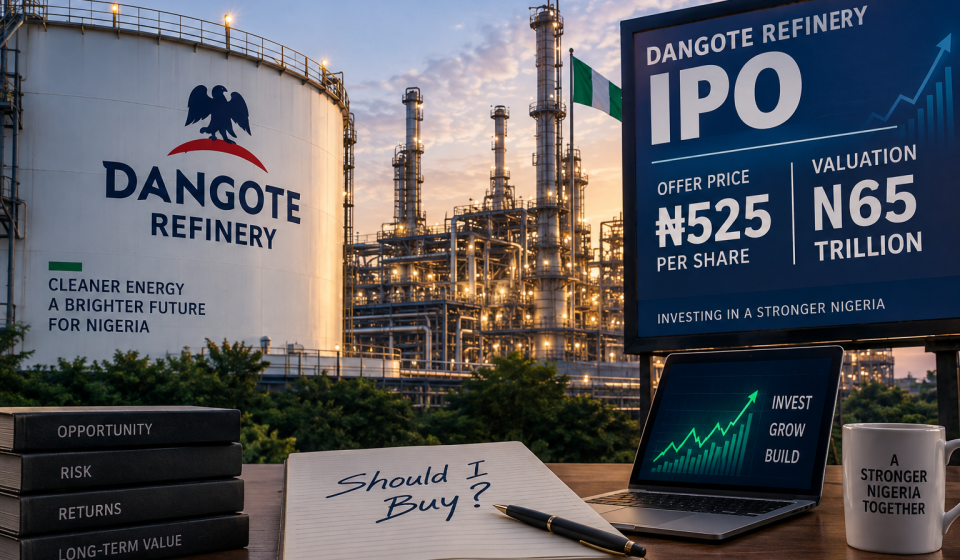
Approximately 4.1 billion new shares are being offered, targeting about ₦2.15 trillion in proceeds.
Before the offer, the refinery has approximately 120.13 billion shares. After adding the new shares, the total would be approximately 124.23 billion.
Multiply those shares by ₦525 and you arrive at an indicative valuation of approximately ₦65.2 trillion, or roughly US$47 billion to US$49 billion depending on the exchange rate figure you use.
So the question is not really whether ₦525 sounds affordable. The question is whether the refinery is worth approximately ₦65 trillion.
And people already disagree about the answer.
How much is the refinery actually worth?
Some valuations cited by some sources put the fair value of Dangote refinery at approximately ₦77.7 trillion to ₦82.6 trillion.
If those estimates prove reasonable, a ₦65.2 trillion IPO valuation could leave room for investors.
But another independent valuation arrived at approximately ₦374 per share under a more conservative discounted-cash-flow scenario. Which is substantially below ₦525.
Here we have the same refinery. Different assumptions. And of course, very different answer.
So what explains the disagreement?
Part of it may come down to a number most people buying their first refinery stock probably do not discuss over dinner: the gross refining margin.
The number hiding inside the refinery
A refinery buys crude oil and converts it into more valuable products.
If crude costs the equivalent of $80 per barrel and the resulting refined products are worth $90, the refinery has not economically “earned $90” simply because that is the value of its output.
What matters is the difference between the cost of the crude going in and the value of the products coming out, adjusted for operating costs and product mix.
That brings us to Gross Refining Margin, or GRM.
A source cites management estimates around $24.20 per barrel as Dangote Refinery’s GRM, while one independent analysis used a more conservative long-run assumption of about $19.50.
That difference may look small. But across hundreds of thousands of barrels every day, it isn’t.
A few dollars of margin per barrel can change a refinery’s valuation by billions of dollars.
And that becomes particularly important because Dangote Refinery’s recent financial turnaround has been dramatic.
The refinery commenced commercial operations only in 2024. For 2025, it reported an approximately $476 million loss.
And for the first half of 2026? There was a silver lining in the sky. An approximately $1.82 billion profit was reported.
That is a remarkable reversal.
But which number tells us more about the refinery’s long-term earning power?
Perhaps neither does on its own.
The question investors need to answer is how much of the 2026 performance can continue when refining conditions become more normal. When the US-Iran war is over. When the price per barrel of crude oil drops below $100.
And then there is the crude oil
You can build a magnificent refinery. You can install sophisticated equipment. You can create enormous processing capacity.
But without enough crude oil entering the facility at an economically attractive price, none of that matters very much.
Dangote Refinery ideally wants Nigerian crude, but it has faced difficulties around domestic availability and pricing. It has consequently imported crude, including US WTI Midland.
The situation appears to have improved. The refinery secured at least 16 million barrels for October 2026 delivery, equivalent to roughly 520,000 barrels per day, including both Nigerian and imported crude.
But 520,000 barrels is not the end of this story.
Current capacity is approximately 700,000 barrels per day. And management wants to double it.
The 1.4-million-barrel bet
Dangote plans to increase refinery capacity from approximately 700,000 barrels per day to 1.4 million barrels per day by around 2029.
Estimated cost? About $14.3 billion.
The original refinery itself reportedly cost approximately $20 billion.
So investors are not simply being asked to buy an operating refinery. They are being asked to buy an operating refinery while an enormous expansion programme lies ahead.
That could create extraordinary additional earnings if utilisation rises, margins remain attractive, sufficient crude is secured and the expansion is successfully completed.
Or it could create additional financing and execution pressures if those assumptions do not work as planned.
And there is an obvious mathematical problem hiding inside the expansion.
A 700,000-barrel refinery needs crude. And a 1.4-million-barrel refinery needs considerably more.
The useful question therefore isn’t simply, “Can Dangote get crude?”
It is whether the refinery can consistently obtain the crude required to operate close to capacity at prices that preserve attractive margins.
READ also: Nigeria’s Dividend Tax Rules—Here’s What Investors Need to Know in 2026
Where is your ₦525 going?
There is another question every prospective investor or shareholder should ask before handing over money.
What will the IPO proceeds actually be used for?
The offer is targeting roughly ₦2.15 trillion.
That money could potentially support productive investment, expansion, working capital, tank farms, distribution infrastructure, debt repayment or other uses identified in the offer documents.
Those alternatives are not economically identical for a new shareholder.
Money invested in productive assets capable of generating attractive returns is different from money used to meet existing obligations.
That is why the formal prospectus matters.
Investors should want to know what percentage goes where, what obligations already exist, how the planned expansion will be financed and how much additional capital may eventually be required.
There is also the ownership question
About 4.1 billion new shares are being offered against approximately 120.13 billion existing shares.
That means the number of shares entering public hands through this offer is relatively small compared with the enlarged company.
Why should investors care? Why should you care?
Because free float can affect liquidity, minority shareholder influence, price discovery, scarcity, volatility and corporate governance.
A stock can rise because the underlying business is becoming more valuable.
It can also rise because relatively few shares are available to satisfy demand.
Those are not necessarily the same thing.
And the retail branding of this IPO makes that distinction particularly important.
It’s touted “The IPO for the People”
The offer has deliberately been presented as “The IPO for the People.”
The minimum subscription is only 10 shares.
At ₦525 each, that means ₦5,250. That makes participation accessible to a large number of retail investors.
But accessibility does not remove investment risk. It can create another kind of risk: buying because everybody else appears to be buying.
Various sources have identified several behaviours investors should guard against—FOMO, brand-based investing, celebrity-founder bias, first-day speculation and valuation blindness.
The Dangote stock-market record gives us a useful warning here.
Dangote Sugar share price rose immediately after listing. Dangote Cement did not. Dangote Cement stayed at ₦135 for several trading sessions and then fell to ₦128.25.
Years later, it became the strongest long-term share-price story among the historical cases examined.
So what will Dangote Refinery do on its first trading day?
Nobody can answer that from the Dangote name alone. And perhaps investors are asking the wrong question anyway.
The more useful question is what the refinery could be worth after crude costs, refining margins, debt, expansion spending, currency exposure and the rights of minority shareholders have all had their say.
That takes us from the refinery’s enormous promise to something equally important.
What could go wrong?
Over to you: What could possibly go wrong regarding Dangote refinery’s share price on its first trading day? Let’s see your answer in the comment box below.